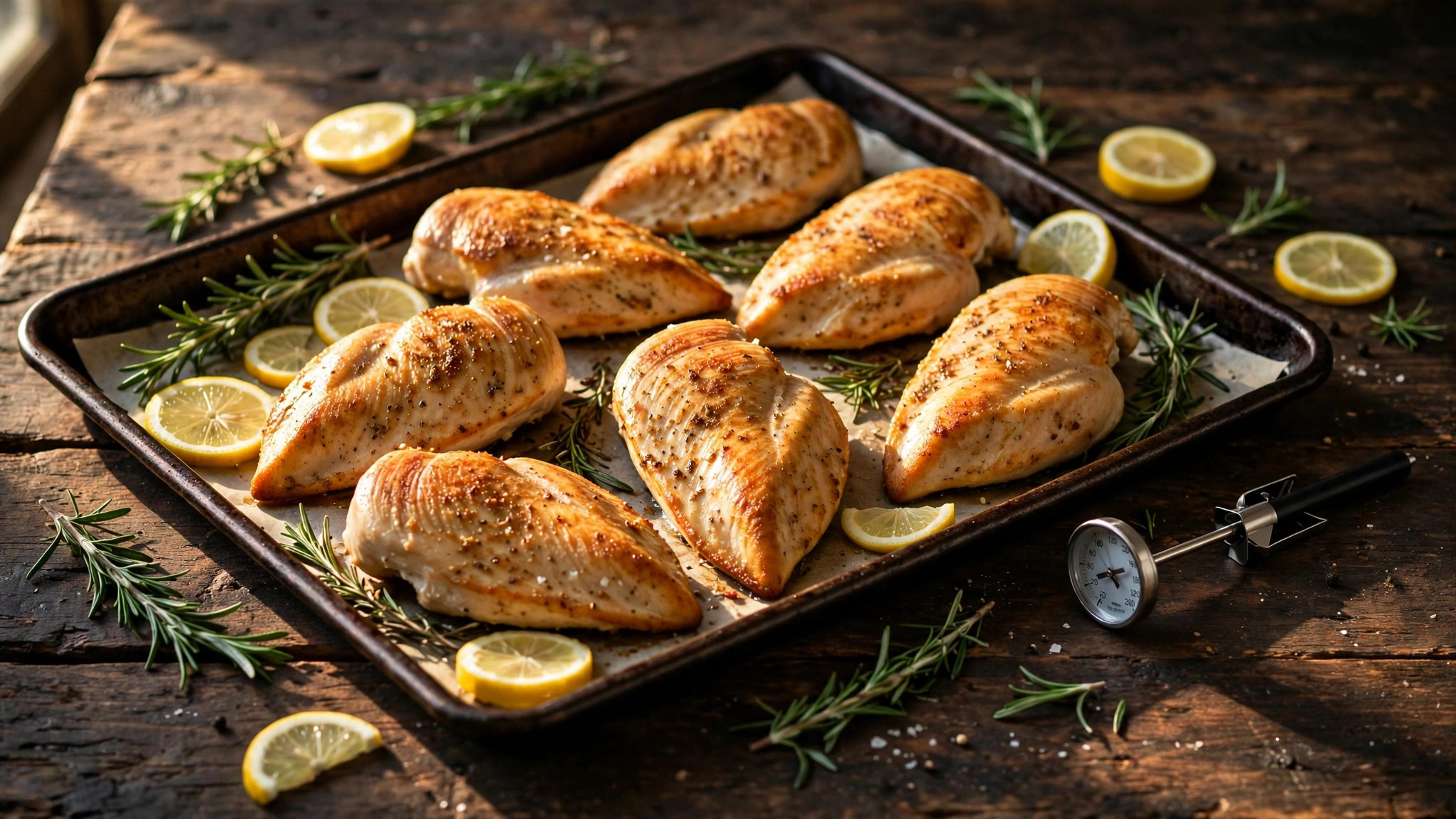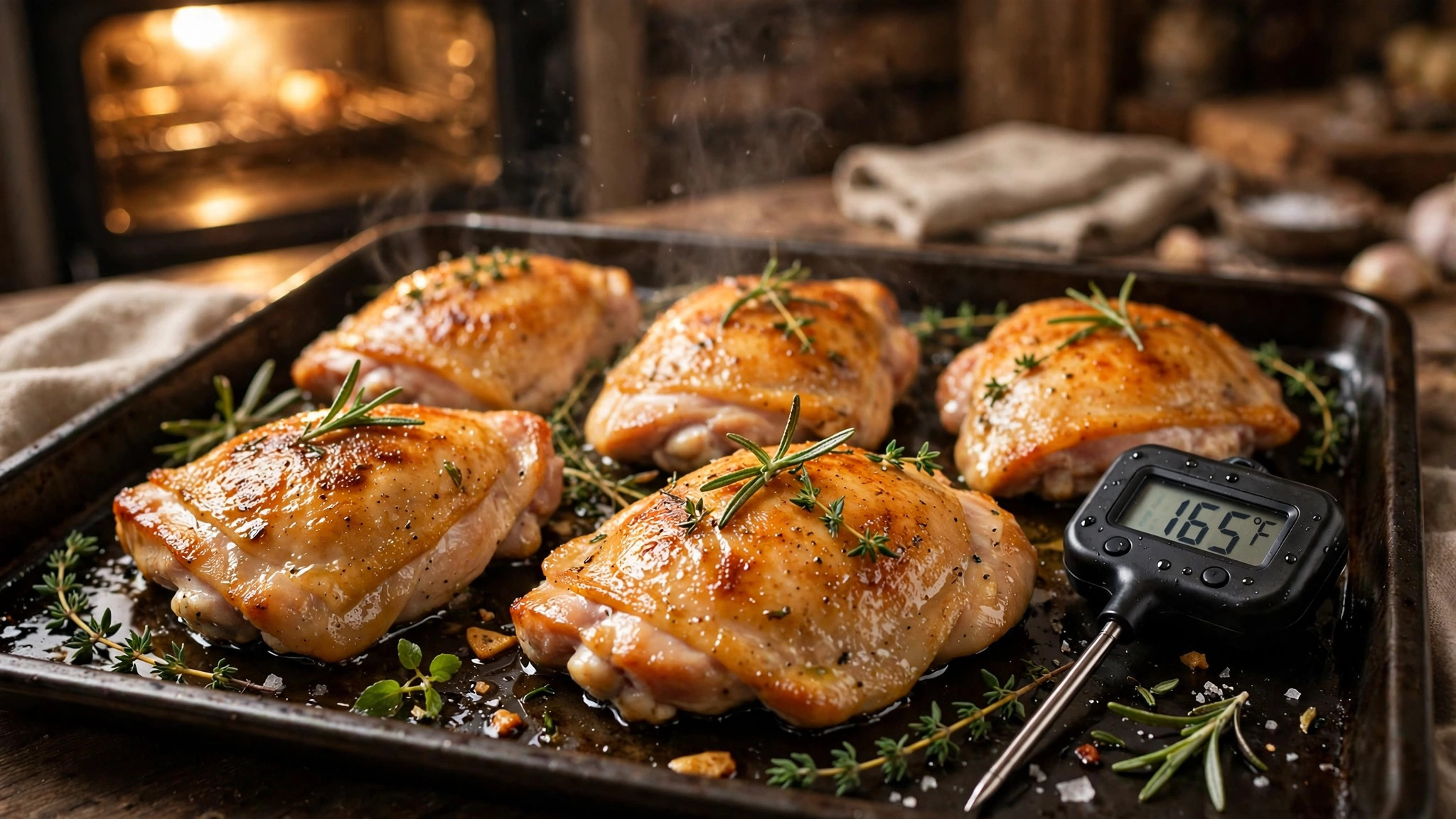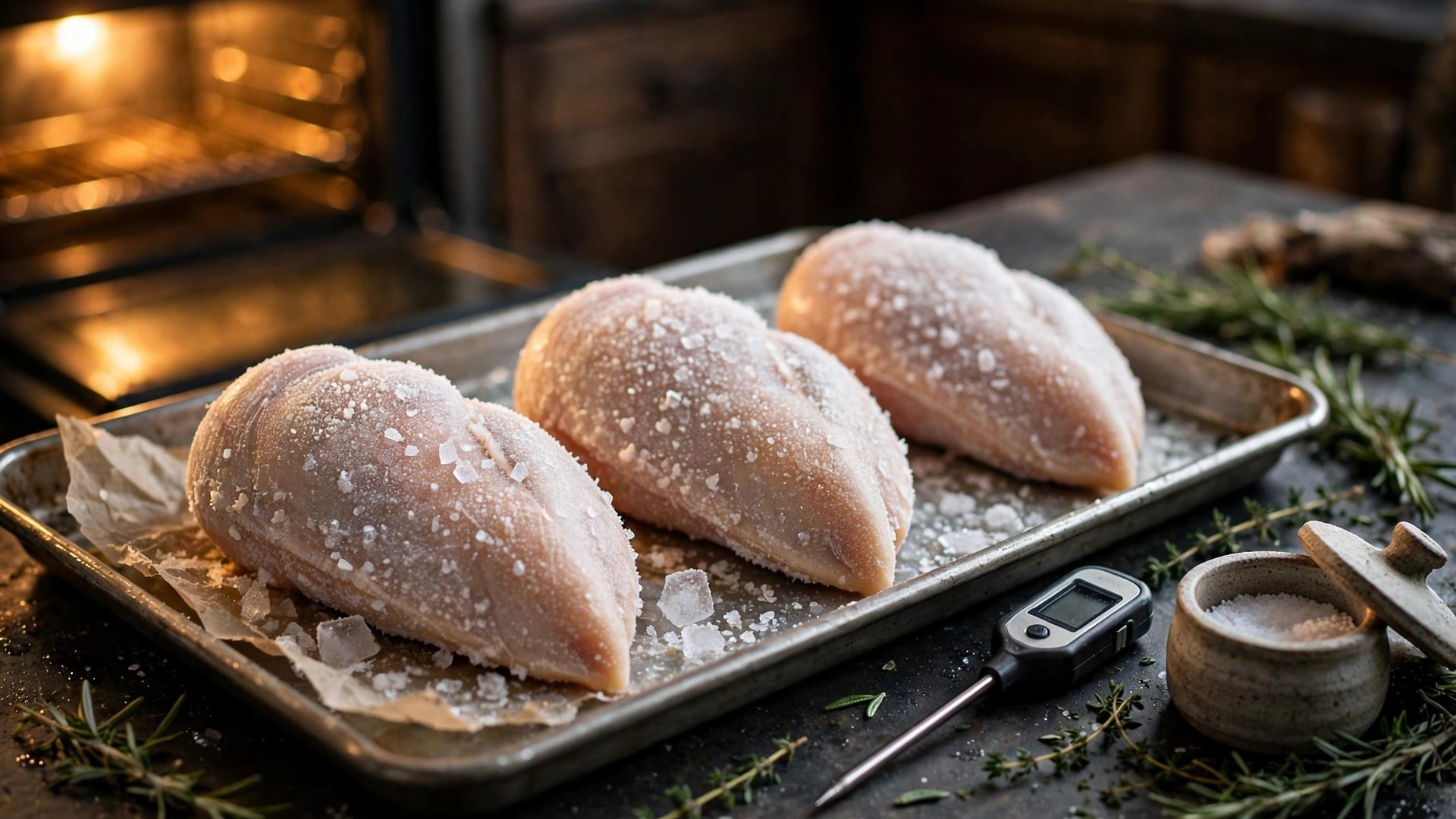
It's 6:40 PM, dinner was supposed to start thawing this morning, and the chicken breasts are still frozen solid in a baggie, fused together like hockey pucks. Here's the good news: you don't have to order takeout. The USDA's Food Safety and Inspection Service says it's perfectly safe to cook meat straight from frozen — it just takes about 50% longer than thawed. Your oven doesn't care whether the chicken started frozen. It only cares where it finishes: 165°F in the thickest part.
Thawed first is still the better dinner — seasoning sticks, edges brown, texture wins. But frozen-to-oven is the better weeknight dinner, because it's dinner instead of cereal. If you've got thawed breasts tonight, skip straight to our 375°F chicken breast guide. The rest of you: preheat the oven and keep reading.
The Quick Answer: How Much Extra Time
Oven fully preheated, breasts on a rimmed sheet pan (parchment or foil), not touching. Times are for standard boneless, skinless breasts, 6–8 oz each. The frozen column is the thawed column plus about 50%, per the USDA's guidance — always start checking at the low end, because the thermometer is the law and the clock is just a guess.
| Oven temp | Thawed | From frozen | Extra time |
|---|---|---|---|
| 375°F / 190°C | 20–25 min | 30–40 min | ~10–15 min |
| 400°F / 204°C | 20–28 min | 30–45 min | ~10–15 min |
| 425°F / 220°C | 18–25 min | 30–40 min | ~12–15 min |
The pattern to remember: frozen breasts land in the same neighborhood whatever the oven temp — about half an hour to 45 minutes. The first 15 minutes are mostly thawing; the actual cooking happens in the back half. That's also why the thermometer matters more here than anywhere else.
Why Frozen Takes So Much Longer
Two things are working against you. First, a frozen breast is a block of ice the oven has to melt before it can start cooking the meat — that's the 50% the USDA quotes. Second, and this is the sneaky one, the outside and inside are running completely different races. The outside of a frozen breast hits browning temperatures while the inside is still thawing, which means the edges can overcook and go rubbery before the center is safe. That's not a reason to panic — it's the reason for rule #3 below: tent with foil if the outside is browning too fast, and trust the thermometer, not the color.
One honest note: frozen-baked chicken is never quite as juicy as thawed — ice crystals puncture the fibers and some moisture runs off as they melt. Rest it properly (rule #4) so whatever juices remain settle back in.
The 4 Rules of Baking Frozen Chicken Breast
Follow these and the frozen brick becomes dinner. Skip them and you get hockey pucks that are brown on the outside and suspicious in the middle.
1. Season halfway, not at the start
Here's the thing nobody tells you: seasoning slides right off a frozen breast. The ice melts, the salt and spices wash down the sides, and you end up with bland chicken and a seasoned sheet pan. The fix is stupidly simple — brush the frozen breasts with a tablespoon of olive oil, bake them naked for 15 minutes, then season generously (1 tsp kosher salt, ½ tsp pepper, 1 tsp garlic powder per breast), and finish the bake. The surface is thawed by then, the oil gives the seasoning something to grip, and everything actually sticks.
2. Give them space
Frozen breasts weep water as they thaw in the oven — a lot of it. If they're crowded together, they steam in their own meltwater and you get pale, rubbery chicken. Space them at least an inch apart on a rimmed pan (the rim matters, because that meltwater goes somewhere). No rack needed, but if you have a wire rack that fits the pan, use it — air circulating underneath means no soggy bottoms.
3. Foil-tent if the outside races ahead
Check at the 25-minute mark. If the outside is already deeply browned but the thickest part reads under 150°F on your thermometer, lay a loose sheet of foil over the pan. The foil reflects heat off the surface while the inside keeps climbing — it buys the center time without burning the edges. Pull the foil for the last 5 minutes if you want a little color back.
4. Rest them like you mean it
Rest frozen-baked breasts a full 10 minutes under the foil tent — longer than the usual 5. The rest does two jobs: carryover heat adds the last few degrees (plan to pull them at 160–162°F and let them coast to 165°F), and the extra time lets juices that were squeezed loose during that long bake redistribute. Slice one open early and watch the juice pool on the board instead of staying in the meat. The wait is the whole difference.
The Slow Cooker Exception — Read This
Everything above is about the oven. The slow cooker is a different animal, and the USDA draws a hard line there: always thaw meat and poultry before putting it in a slow cooker. The low, slow heat leaves frozen chicken sitting in the bacterial danger zone (40–140°F) for far too long, and no amount of extra time makes that safe. If the crockpot was your plan, thaw first — or go oven tonight and crockpot tomorrow. (For more on the frozen-from-raw safety rules, this USDA-cited freezer food safety FAQ covers the 50%-longer rule and thawing methods in detail.)
If You Have 60 Minutes: The Fast Safe Thaw
Honestly, the best move is often not to bake from frozen at all — it's to thaw fast and then bake. The USDA-approved cold-water method: seal the breasts in a leak-proof bag, submerge in a bowl of cold water, and change the water every 30 minutes. Two breasts thaw in about an hour. Never use hot water (it warms the outside into the danger zone while the inside stays frozen) and never leave chicken on the counter to thaw — the USDA is clear that counter thawing is never safe. Once thawed, the breast cooks on the normal schedule: 20–25 minutes at 375°F.
What NOT to Do
Three mistakes that turn "I baked it from frozen" into a bad story:
- Thawing on the counter. The outside of the breast sits at room temperature for hours while the middle thaws — prime time for bacteria. The USDA has never approved this and never will.
- Skipping the thermometer. Frozen-to-oven cooking is the one situation where you absolutely cannot eyeball it. An instant-read thermometer is the only way to confirm the middle actually reached 165°F (74°C) — the frozen-meat cooking guide at KitchPrep says it well: the extra time is a planning estimate, the thermometer is the verdict.
- High heat to "catch up." Cranking to 475°F to make up for lost time just burns the outside while the inside lags further behind. Stick to 375–425°F and give it the time it needs.
FAQ
Is it really safe to cook chicken from frozen? Yes — the USDA Food Safety and Inspection Service says meat and poultry can be cooked from frozen; it takes approximately 50% longer than thawed. The one exception is the slow cooker: always thaw first.
Can I bake frozen chicken breast at 350°F? You can, but it'll take 45–60 minutes, and the long, slow bake dries lean breast meat out. 375–425°F is the sweet spot — fast enough to keep it juicy, hot enough to get real browning.
Do I need to adjust for bone-in or big breasts? Yes — anything over 8 oz, or bone-in pieces, needs the top of the ranges above and possibly beyond. Bone slows heat transfer, so check temp in the thickest part near (not touching) the bone.
What internal temp am I aiming for? 165°F (74°C) in the thickest part, measured with an instant-read thermometer — the USDA's safe minimum for all poultry, per this poultry temperature chart. Pull at 160–162°F and let carryover finish the job.
"The clock is a guess. The thermometer is the verdict. That sentence matters twice as much with frozen chicken."
Want the thawed-breast version for comparison? How Long to Bake Chicken Breast at 375°F has the full method. Cooking thighs instead — where the temp rules are friendlier? 165 vs 175: which internal temp is better for chicken thighs settles it. And if you want the hands-off forgiving cut, baked boneless skinless thighs at 425°F basically cook themselves.